By Emily Hahn, Education Curator
There’s a moment most days where I’m doing at least three things at once, and all of them matter.
A lesson plan is open on one screen, aligned to Arizona State Standards. I’m answering a message about an upcoming outreach event. There’s a newsletter draft waiting for edits. In the background, I’m tracking a project timeline that depends on multiple departments, external partners, and a deadline that isn’t moving.
Museum education doesn’t stay in one lane. It stretches constantly.
One hour, I’m building a lesson plan for middle school students. That means more than just writing content. It’s pacing, vocabulary, engagement, and making sure a teacher can pick it up and use it immediately in a real classroom. If it doesn’t work for them, it doesn’t work.
The next hour, I’m shifting into project management mode. I’m tracking education materials tied to exhibits, coordinating across teams, and following up on timelines that rely on multiple people doing different parts of the same project. It’s less about control and more about momentum. The goal is to keep things moving without losing clarity.
Then there are tours. 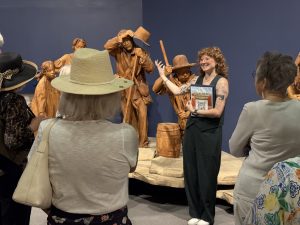
Tours are where planning meets people. That could be a school group seeing Arizona history up close for the first time, a club digging deeper into a specific topic, a retirement community bringing lived experience into the conversation, or even other museum professionals visiting from across the Phoenix metro area. Every group comes in with different expectations and different levels of familiarity. The structure matters, but so does the ability to adapt in real time.
Then there are traveling trunks.
On the surface, they look simple. Boxes of artifacts and lesson materials that go out to classrooms. In reality, each one moves through a full development cycle. We build the theme, assemble materials, test with educators, schedule use, and follow up after it returns. Every trunk has to function independently in a classroom we may never see, which means everything from instructions to durability has to be intentional.
At the same time, I’m developing teacher professional development workshops. 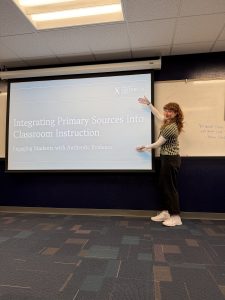
This is a different kind of design. You are not just delivering content. You are working with educators as professionals. It has to be meaningful, applicable, and worth their time. Whether it focuses on primary sources or classroom strategy, the goal is the same. Give them something they can use the next day.
Layered into that are intern projects.
Working with ASU students means building projects that are structured enough to guide them, but flexible enough to let them contribute in a real way. It is mentorship, project design, and supervision at the same time. You are thinking about outcomes for them and for the institution.
Then there’s outreach. 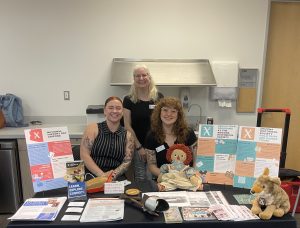
Outreach is where everything meets the public. It might be tabling at an event, building partnerships with educators, or giving a speaking engagement. Sometimes it is standing in front of a group and illustrating Arizona’s history to anyone who is willing to listen. Every audience is different. Some are deeply familiar. Others are encountering these stories for the first time. The work is in meeting them where they are and making the history matter in that moment.
And then there’s NHDAZ. 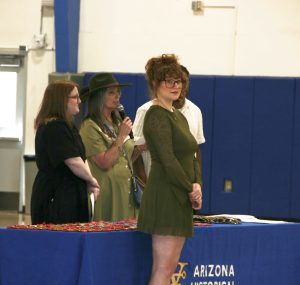
National History Day Arizona runs right through the middle of everything. During the season, I am photographing competitions, managing Facebook and Instagram content in real time, judging student projects, and helping coordinate awards so the entire event runs
smoothly. It is fast-paced, high-energy, and completely student-centered.
After that, the work shifts, but it does not slow down. Planning for the national competition means logistics, communication, and making sure Arizona students are supported at the next level. For me, that includes building out plans for travel to University of Maryland, my alma mater, which adds a personal layer to an already complex process.
In between all of that, there is communication work holding everything together.
Newsletters. Pamphlets. Social media. Each one has a different purpose and a different audience. A
newsletter needs structure and clarity. A pamphlet has to stand on its own. Social media has to be
immediate, but still meaningful. It is not just promotion. It is access.
And then there’s photography.
Capturing programs, exhibits, and events is not just documentation. It is storytelling. Those images become part of how we represent the work later, whether that is outreach, reporting, or public
engagement. You are thinking about composition, timing, and what the moment will communicate after it is over.
All of this feeds into something larger: how the organization grows. 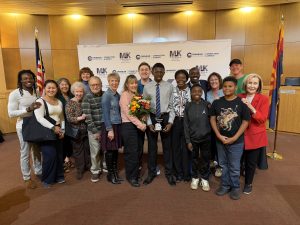
Program development. Systems that work. Finding ways to make education offerings more accessible and more effective. This kind of work does not have a clear endpoint. It is iterative and built through collaboration and constant adjustment.
And none of it happens alone.
This job is built on relationships, across the agency and beyond it. Colleagues, educators, community partners, students. Every project depends on communication, trust, and a shared understanding of what we are trying to do.
So yes, most days feel like being pulled in multiple directions.
But it is not scattered. 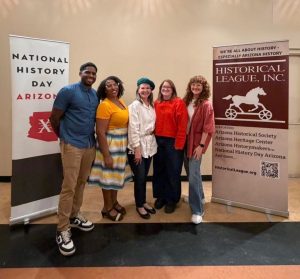
Each piece connects. The lesson plan informs the workshop. The workshop shapes outreach. Outreach builds partnerships. Partnerships make programs possible. Tours bring people into the space. Traveling trunks send that experience back out. NHDAZ connects students directly into that pipeline, turning research into something public, visible, and meaningful.
It stretches, but it holds.
There is a line I come back to more than I expected. In The Incredibles, Elastigirl does not stretch just because she can. She stretches because the situation requires it. Staying rigid would mean something gets missed.
That is what this work feels like.
Because at the center of all of it, this is not about juggling tasks. It is about access.
It is about making sure a third grader, a teacher, a retiree, a college intern, or any student presenting at NHDAZ all have a way into history. That they can see themselves in it, question it, and carry it forward.
If that means being pulled in every direction, then that is exactly where I need to be.