
Unpacking the Story of Winnie Ruth Judd
Almost every day at the Arizona Heritage Center Museum, as guests leave the building I try to share some obscure history that might not be curated into their experience on that day.
During women’s history month, I chose a rather notorious and infamous historical Arizona figure affectionately nicknamed the “Trunk Murderess,” a.k.a. Winnie Ruth Judd. Back in 1931, Winnie Ruth was accused of murdering two women and trying to ship their bodies to Los Angeles packed in trunks. Did she do it? Was she framed? Who was her accomplice? We may never know, but we do know a lot about her alleged crime, her wild and crazy, nationally high-profile trial, her escapes from the Arizona State Asylum for the Insane, and that Winnie Ruth was, by many accounts, actually a very likable person.
It was 1931, and there were men making their fortunes in the Phoenix area. The area was not only a destination to cure yourself from tuberculosis, but the first “snowbirds” were beginning to seasonally visit for extended amounts of time. Winnie Ruth, like many of us, came to Arizona to start over. Her older husband had been institutionalized and couldn’t keep a job as a doctor due to his addictions. She was among the many ladies who introduced themselves as widows. It was tough for women in 1931.
Winnie found work at a tuberculosis sanatorium, where she befriended two women, Anne LeRoi and Hedvig “Sammy” Samuelson. It wasn’t unusual at the time for Phoenix men to have affairs with the women working in the healthcare clinics while their wives went to cooler locations when the weather got hot. They were referred to as “summer wives,” and Winnie, Anne, and Sammy all became involved with a man named “Happy” Jack Halloran.
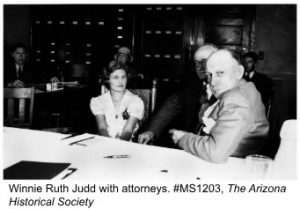
It is still not clear what happened that October night when Anne and Sammy were killed, but Winnie was in possession of their corpses. Judd transported the victims’ bodies, one of them dismembered, from Phoenix to Los Angeles by train inside trunks and other luggage. One of the pieces of luggage started to leak and the conductor refused to give it to Winnie, thinking it was just smuggled deer meat. When he called the police, Winnie’s unsuspecting brother made the perfect get-away driver as he showed up to meet her. He knew nothing about the murders or the bodies in the trunks that Winnie had left at the station, and she was able to escape in the chaos of the moment.
The police tracked Winnie down and apprehended her at the Alvarez and Moore Funeral Chapel in Los Angeles. She was disheveled and delirious on her way back to Phoenix to face a trial. A trial that would make Phoenix a household name, as radio broadcasts covered the story almost nationwide.
Back in Phoenix, Winnie was tried by a jury of all men. She was found guilty and sentenced to death, but later determined to be mentally incompetent and committed to the state mental asylum. There is a good chance that Winnie was also spared the death penalty, because there had been a recent execution of a woman by hanging, where the person was decapitated. The men who had obvious ties to the murders mostly avoided scrutiny because they were local tycoons, big names in the Phoenix area.
While in the asylum, Winnie acquired a key to the front door, and let herself out into Phoenix 6 times, only to be caught and returned to the institution. On the 7th effort Winnie successfully avoided being caught for several years, although eventually she was eventually brought back to prison. Decades of further questioning on the people and evidence surrounding the case led to Ms. Judd being pardoned by Arizona Governor Jack Williams.
I became fascinated with this local story after the opening of Valley Bar, a popular basement bar, installed a backlit art piece that casts shadows onto a circular scrim illustrating the story of Winnie. I love the mystery around the things that went on socially as Phoenix became a big city. I always capture the attention of Arizona Heritage guests as I give them this story to go home and look up. I was personally fascinated with the life of women in the 1930’s and the way that a crime story from the middle of the Sonoran Desert became national focus.
For More Information:
Book “The Trunk Murderess” by Jana Bommersbach
Book “Murderess” by Laurie Notaro
Todd Bailey
Special Projects Coordinator
Email Todd | 480-387-5365